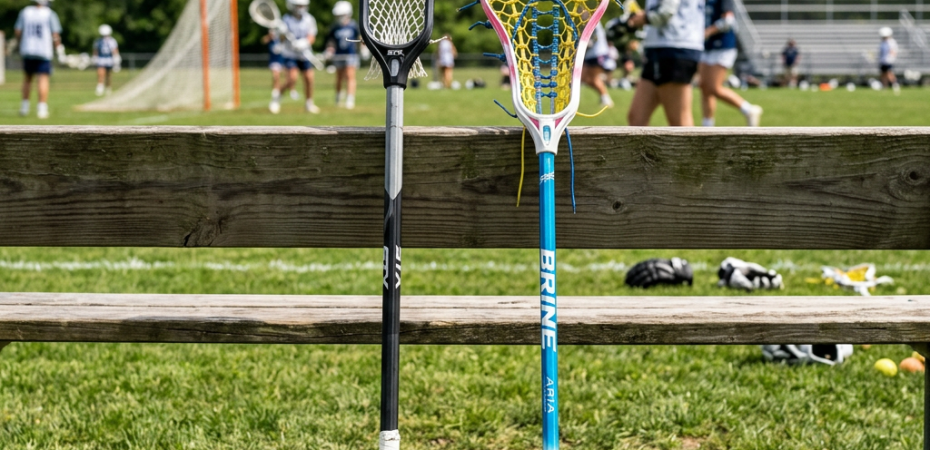
Watching my kid play sports naturally turns my mind to sociological theory. I had to pull the referee aside after the game to thank him: watching him ref the game and hearing his explanations of the calls taught me a great deal about about the rules of lacrosse, and the logic of various defensive and offensive stratagems. It’s one thing to understand the rules and to try to interpret the movements of the players: Something else to see those translated into live qualitative motion and interpretation: into whistles, gestures, penalties, and “play on!” — the action signifying intentional non-action.
We’re latecomers to the world of lacrosse — one of my kids tried it on a lark and wanted to sign up, so we bought some cool equipment and dove in. Fast forward by a year, and the commitment has multiplied into two kids, a small mound of armor and sticks, and a busy schedule evenings and weekends from January to May.
9 p.m. on a Thursday finds me on a wind-swept pitch as I try to do my job: drive them to and fro, cheer at the appropriate moments with the appropriate sentiments (“de-FENSE”, “nice shot!” “ah, unlucky”), supply blue drinks and orange wedges, and find the closest frozen yogurt parlor before we trek home from a match in one corner of the realm or other.
The girls’ game and the boys’ game are almost two different sports, except for the goals, balls, and soccer-like field. The sticks look similar but have a different structure and require different techniques to use properly. Permissible actions and approaches vary wildly.
For girls, it’s rather like low-contact basketball without the dribbling (the ‘crease’ is large semi-circular version of the ‘key’ in basketball, and they can’t push each other with anything but their hips, although some careful stick-to-stick contact seems allowed).
For boys it seems to be more like hockey without the ice and puck (they’re supposed to smack each other with the sticks!, and “push him out of bounds” is a typical and expected strategy!).
All this is to say, my instincts for the game are not particularly well-honed. And so it was a delight to watch a referee who educated as he adjudicated and facilitated the flow of the game: sharp eyes on the lines and the contact levels, explaining the calls and the counts, identifying the offending player by number without shaming.
I said sociology though, and I do promise I’m getting round to that bit.
Norms and their enforcement is an evergreen topic in social research: how do we devise, learn, and enforce all the rules that govern our behavior? Whether we’re learning by watching what people do (descriptive norms) or trying to translate declared rules (injunctive norms) into action, we adjust to one another and move through the world in a string of micro norm negotiations: passing our multi-ton vehicles by one another on the street only a few feet apart with remarkably few collisions, making our way through a supermarket or a conference without distress or chaos, settling in with our favorite people for a lazy afternoon of board games and finger food.
Sporting matches are a nonstop sequence of norm adjustment among players, coaches, refs, and spectators: how big is the strike zone going to be? Inadvertent contact or a foul? Offsides or play on? Offsetting penalties? Double technicals? Finishing through contact or a travel?
All this is to say — how quickly we can learn new norms, at least when we agree on the legitimacy of the enforcer — so long as the enforcer quickly and dispassionately states the call as it’s made, and then lets us all get back to what we’re really there for: “beautiful play!”

